You can read Post 10 here, or find the series page here.
Introduction
Jonathan Edwards wrote and spoke of God as Triune and in Trinitarian terms – Father, Son, and Holy Spirit. Unlike Allah (see Post 2), this Triune God of Scripture of whom Edwards preached was not inward focused and negative, and neither was His glory.
Edwards proclaimed that God is “independently glorious and happy.”[1] A God who, because He is Triune, has a “grand design of redemption.”[2] A God who, because He is gracious and outgoing, creates the universe with intelligent and relational human beings.
God’s Glory Before Creation
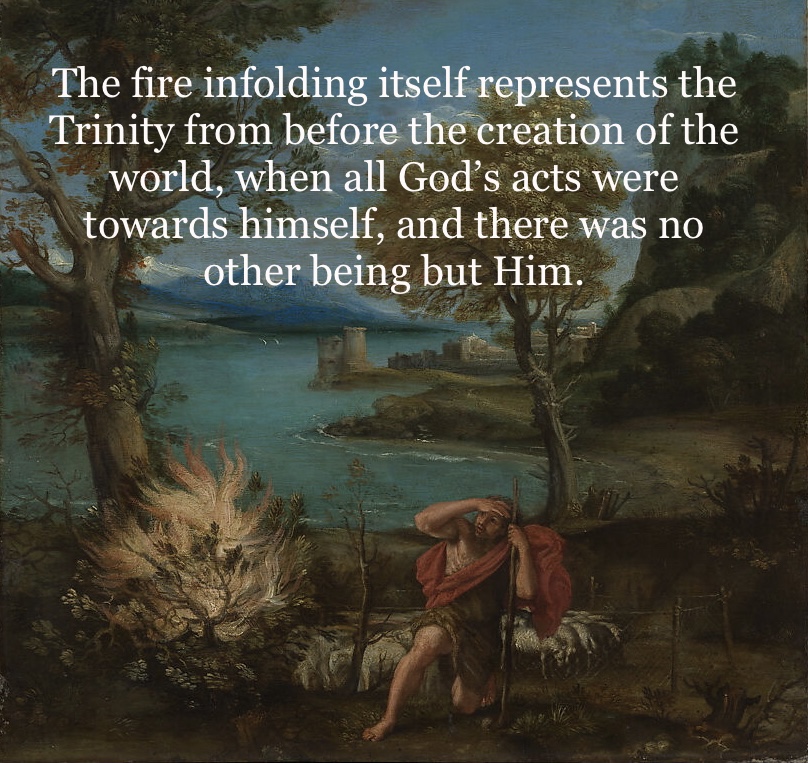
Before creation, God was infinitely glorious. He was infinitely bright and burning with goodness. He was infinitely loving. Edwards described this reality from Ezekiel’s vision of the whirlwind of the LORD coming before the chariot of God in Ezekiel 1:4,
And I looked, and, behold, a whirlwind came out of the north, a great cloud, and a fire infolding itself, and a brightness was about it, and out of the midst thereof as the colour of amber, out of the midst of the fire.[3]
“This fire,” said Edwards, “infolding itself, does especially represent the Deity before the creation of the world… when all God’s acts were only towards Himself, for then there was no other being but He.”[4]
Father, Son, and Spirit shone eternally brightly in love on One another. God was not lacking in love before the universe. Being love, God shone infinitely brightly towards Himself – not selfishly, but lavishly: the Father to the Son in begetting the Son in the Holy Spirit, the Son loving the Father in the Spirit, and the Spirit loving the Father and the Son, united in mutual delight.
This lavishness did not expend His glory. This was His glory. Rather than being exhausted like normal fire which goes out from itself, this Divine Triune Fire – the flames of the love of the Lord – came back into its center, making it infinitely bright and hot.[5] In this way “The flames of divine love are received and infolded into the bosom of the [Triune] Deity.”[6]
Because Edwards saw God’s glory before creation with such clarity, the idea that God created the universe for His own existence, or so that He could attain certain attributes or perfections, or that He could gain fanfare, was absurd.[7] God is “infinitely, eternally, unchangeably, and independently glorious and happy: that He cannot be profited by, or receive anything from, His creatures; or be the subject of any sufferings, or diminution of His glory and felicity, from any other being.”[8] This was entirely different from the glory of Allah, whose glory is brightest when it is alone, and darkest when he is not constantly praised: “Glory be to Allah, high above what they associate.”[9]
God is Creator. He cannot obtain something from His creation.[10] And God is love. He cannot derive any motivation to create from a desire for the creatures’ happiness,[11] or from a desire to exercise an attribute which He did or did not possess.[12] In this way, like Calvin before him, Edwards held that God’s Triune goodness was His sole motivation for creating and sustaining the universe: “God’s goodness to them who are to be the eternal subjects of His goodness, is the end of the creation….”[13]
This reasoning is far closer to Calvin than to Mohler. Calvin, as we saw in Post 4, wrote that God’s motivation in creating the world was the same as Edwards proclaimed: God’s goodness:
…if it be asked what cause induced Him to create all things at first, and now inclines Him to preserve them, we shall find that there could be no other cause than His own goodness. But if this is the only cause, nothing more should be required to draw forth our love towards Him; every creature, as the Psalmist reminds us, participating in His mercy. ‘His tender mercies are over all His works,’ (Psalm 145:9).[14]
As with Mohler, Edwards shared the belief that “God’s glory is an ultimate end in creation.”[15] The glory Jonathan Edwards had in mind, however, was entirely different from that of the theatrical glory Mohler presents. When Mohler speaks of God’s glory, he divides God’s intrinsic glory from the external expression of that glory. This, he explained, meant that though God’s intrinsic glory could never fade or lose its luster, His external glory can “wax and wane.”[16] Edwards, on his part, had no such conception.
Edwards, when he wrote of God’s internal and external glory, did so not for the sake of theological accuracy but because of human capacity: “there is a degree of obscurity in these definitions; but perhaps an obscurity which is unavoidable, through the imperfection of language to express things of so sublime a nature.”[17] Edwards said that God’s internal glory is “the fulness of the Godhead,” and His external glory as consisting of “the communication of God’s fulness….”[18] But both His external and internal glory were one.
Unlike many theologians who divorce the two, Edwards did not. Others divided God’s glory such that what was true of God’s external glory might not be the true expression of His internal glory. Edwards understood God’s internal and external glory “to be one thing” expressed “in a variety of views and relations.”[19] This means that all of the ultimate ends [or purposes] of God’s work as described in Scripture, though manifold in their expression, “is one.”[20] Whenever God’s works are signified as the glory of God in Scripture, it is referring to the “emanation and true external expression of God’s internal glory and fullness.”[21] In all of God’s emanating communications, He is communicating nothing other than Himself in all of His own fullness.
This is why, as will be shown in the upcoming Posts, when God brings sinners into communion with Himself and to His glory, He gives them His Spirit. The Spirit is Himself the delight and the love of the Father and the Son towards Themselves,[22] the “river of God’s pleasures.”[23] When, therefore, God creates, the Spirit goes out (Genesis 1:2). And when God redeems, the Spirit goes out (Romans 5:5; Galatians 4:29). In His works of creation and redemption, He is expressing His glory so that His elect would come to Him in His glory, and communicating Himself to them in Jesus by the Spirit.
Feel free to like and share these posts more broadly.
If you like, you can download a copy of this article below:
[1] Jonathan Edwards (n.d.). The Works of Jonathan Edwards, Volume One. Christian Classics Ethereal Library. Grand Rapids, MI. p. 789.
[2] Jonathan Edwards (n.d.). The Works of Jonathan Edwards, Volume Two. Christian Classics Ethereal Library. Grand Rapids, MI. p. 2121.
[3] Ezekiel 1:4, KJV, BlueLetterBible https://www.blueletterbible.org/kjv/eze/1/4/s_803004
[4] Jonathan Edwards (n.d.). The Works of Jonathan Edwards, Volume Two. Christian Classics Ethereal Library. Grand Rapids, MI. p. 2121-2122.
[5] In Exodus 3, Moses (like Ezekiel) saw something of this: the self-sustaining fire in the midst of the bush, and yet the bush was not consumed. Only God can sustain Himself without fuel or any outside energy. He is who He is: “I Am who I Am” (Exodus 3:14).
[6] “This light, in the manner of the subsisting of the Father and the Son, shines on itself: it receives its own brightness into its own bosom. The Deity, in the generation of the Son, shines forth with infinite brightness towards itself, and in the manner of the proceeding of the Holy Ghost, it receives all its own heat into its own bosom, and burns with infinite heat towards itself. The flames of divine love are received and infolded into the bosom of the Deity” [Jonathan Edwards (n.d.). The Works of Jonathan Edwards, Volume Two. Christian Classics Ethereal Library. Grand Rapids, MI. p. 2121].
[7] “It is evident, that God does not make His existence or being the end of the creation; which cannot be supposed without great absurdity. His existence cannot be conceived of but as prior to any of God’s designs. Therefore He cannot create the world to the end that he may have existence; or may have certain attributes and perfections” [Jonathan Edwards (n.d.). The Works of Jonathan Edwards, Volume One. Christian Classics Ethereal Library. Grand Rapids, MI. p. 815].
[8] Jonathan Edwards (n.d.). The Works of Jonathan Edwards, Volume One. Christian Classics Ethereal Library. Grand Rapids, MI. p. 789.
[9] Surah 9.31
[10] George Marsden makes the same case: “The ultimate reason that God creates, said Edwards, is not to remedy some lack in God, but to extend that perfect internal communication of the triune God’s goodness and love. It is an extension of the glory of a perfectly good and loving being to communicate that love to other intelligent beings. God’s joy and happiness and delight in divine perfections is expressed externally by communicating that happiness and delight to created beings. God’s internal perfection or glory radiates externally like the light that radiates from the sun” [George Marsden (2003). Jonathan Edwards: A Life. Yale University Press. New Haven & London. p. 462-463].
[11] “…delight which God has in His creature’s happiness, cannot properly be said to be what God receives from the creature” [Jonathan Edwards (n.d.). The Works of Jonathan Edwards, Volume One. Christian Classics Ethereal Library. Grand Rapids, MI. p. 802].
[12] “…that perfection of God which we call His faithfulness, or His inclination to fulfil His promises to His creatures, could not properly be what moved Him to create the world…” [Jonathan Edwards (n.d.). The Works of Jonathan Edwards, Volume One. Christian Classics Ethereal Library. Grand Rapids, MI. p. 786].
[13] Jonathan Edwards (n.d.). The Works of Jonathan Edwards, Volume One. Christian Classics Ethereal Library. Grand Rapids, MI. p. 842.
[14] John Calvin (1845). The Institutes of the Christian Religion. Christian Classics Ethereal Library. Grand Rapids, MI. p. 44. Emphasis mine.
Calvin says the same in his comments on Romans 1:21, “…His goodness, for there is no other cause [other] than Himself [for] why He created all things, and no other reason, why He should be induced to preserve them…” [John Calvin (n.d.). Commentary on Romans. Christian Classics Ethereal Library. Grand Rapids, MI. p. 50].
[15] Jonathan Edwards (n.d.). The Works of Jonathan Edwards, Volume One. Christian Classics Ethereal Library. Grand Rapids, MI. p. 836.
“It is manifest, that the Scriptures speak, on all occasions, as though God made himself his end in all his works…” [Jonathan Edwards (n.d.). The Works of Jonathan Edwards, Volume One. Christian Classics Ethereal Library. Grand Rapids, MI. p. 814].
[16] Albert Mohler. (2020, May 14). Albert Mohler—The Glorious Gospel of the Blessed God—T4G20. Together for the Gospel (T4G). https://www.youtube.com/watch?v=9l5uZQoNOCg. 16:00-17:00.
[17] Jonathan Edwards (n.d.). The Works of Jonathan Edwards, Volume One. Christian Classics Ethereal Library. Grand Rapids, MI. p. 853.
[18] Jonathan Edwards (n.d.). The Works of Jonathan Edwards, Volume One. Christian Classics Ethereal Library. Grand Rapids, MI. p. 854.
[19] Jonathan Edwards (n.d.). The Works of Jonathan Edwards, Volume One. Christian Classics Ethereal Library. Grand Rapids, MI. p. 853.
[20] “…all that is ever spoken of in the Scripture as an ultimate end of God’s works, is included in that one phrase, the glory of God; which is the name by which the ultimate end of God’s works is most commonly called in Scripture; and seems most aptly to signify the thing” [Jonathan Edwards (n.d.). The Works of Jonathan Edwards, Volume One. Christian Classics Ethereal Library. Grand Rapids, MI. p. 853].
[21] Jonathan Edwards (n.d.). The Works of Jonathan Edwards, Volume One. Christian Classics Ethereal Library. Grand Rapids, MI. p. 853.
[22] Jonathan Edwards (n.d.). A Treatise on Grace. Christian Classic Ethereal Library. Grand Rapids, MI. p. 31.
[23] Jonathan Edwards (n.d.). A Treatise on Grace. Christian Classic Ethereal Library. Grand Rapids, MI. p. 32.
Discover more from Standing Before God, This We Are and No More
Subscribe to get the latest posts sent to your email.
 Standing Before God, This We Are and No More
5 thoughts on “God’s Flaming Glory – God’s Triune Glory, According to Jonathan Edwards – Post 11”