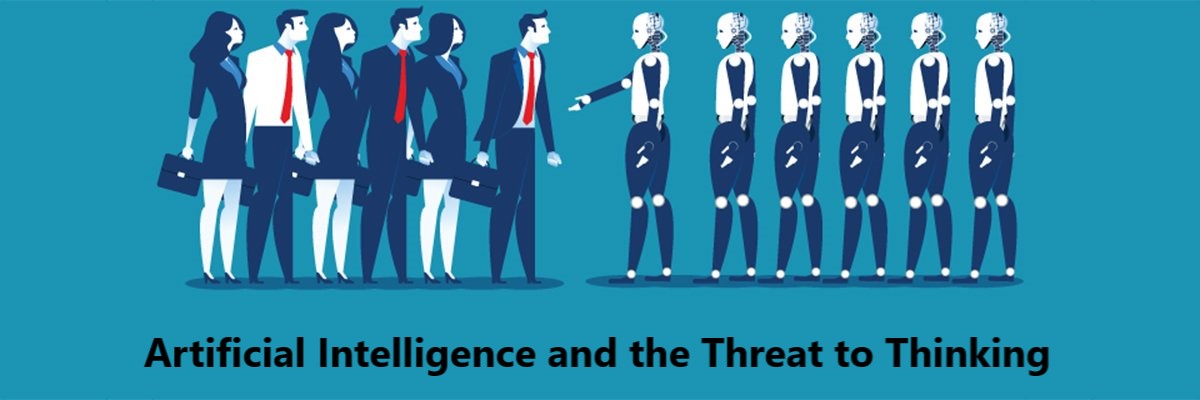
It may be hard to imagine, but there was a time when books did not exist.
It’s hard enough for us to imagine a world without the internet, but what about a world without written books? The internet and the blogosphere is buzzing with talk about the consequences of the internet and the danger of Artificial Intelligence (AI), but did the people who were living at the cusp of the book share similar concerns about that new medium? In a way, yes. And it could help us think through the potential consequences of AI.
Plato, the Greek philosopher, was someone who knew both the potential wonders and dangers of writing and books. On one side of the debate in his day, writing was called a drug that would help memory and wisdom that would protect against forgetfulness [1]. On the other side, it was seen as a drug that acted more like poison, withering memory, and endangering recollection [2].
Tony Reinke writes in his book that Socrates had the same fear: “books would weaken human memory,” implanting “forgetfulness into their souls” [3]. Reinke continues, stating that today, we usually “write things down to forget them.” Socrates, says Reinke, was “concerned with externalized knowledge replacing internalized wisdom.” Were Socrates’ concerns valid? In many aspects, yes. As Reinke reflects, “We make decisions based upon access to external reminders rather than from an internal storehouse of cultivated wisdom” [4].
Are books bad? Of course not! For all of the benefits of books, they changed the landscape of human memory, and not entirely for the better. Yet, it was the internet that truly brought to fruition the concerns Socrates warned about.
The effect the internet has had, however, is tepid compared to the effect AI will have. Books and the internet simply stored human knowledge externally. Now, through AI, thinking itself is being exported. The factories of human thinking, for the first time in history, are being transferred from the mind to the motherboard; human thought is being externalized. The results of such a move could be devastating to human wisdom and our ability to think.
Books did not irradicate the immense capability of human beings to remember. At one point in history, people were walking books, poems, and narratives. Over the centuries, the number of those individuals have decreased, but still there are some places where the traditions continue. One book recounts the efforts made by some scholars to save The Kalevala, a Finnish national epic. The epic was not recorded anywhere but in the memory of itinerant merchants, Finns of Russia. Zacharias Topelius, one of the scholars who saved the epic,
invited these itinerant Finnish merchants to his bedside, and induced them to sing their heroic poems, which he copied as they were uttered. And, when he heard of a renowned Finnish singer, or minstrel, he did all in his power to bring the song-man to his house, in order that he might gather new fragments of the national epic. Thus the first glory of collecting the fragments of the Kalevala and of rescuing it from literary oblivion, belongs to Topelius. In 1822 he published his first collections, and in 1831, his last [5].
Even the internet did not (or could not) completely irradicate long traditions of the legendary ability humans have to memorize massive tomes of knowledge. You could not only find these amazing individuals in Finland two centuries ago, but also less than half a century ago on the coasts of Northern Ireland. There, one still found seanchaidh, or story-tellers, who could recite, from memory, thousands of lines of poetry and narrative stories which had been passed down from one generation to another for centuries (see Michael J. Murphy’s book “Now You’re Talking” published in 1975).
These walking books, these story-tellers, these minstrels, these guardians of deep culture are few and far between now. So much knowledge recorded in books and passed down from memory to memory have been lost to time. Yet, humanity was able to safeguard such knowledge well considering the circumstances human beings have faced, whether it was stored internally or externally. Books offered humanity a different, and in many ways, superior way (if less relational way) to store and transfer their thoughts, ideas, way of life, etc. AI, on the other hand, is too generous in what it offers to humanity (or perhaps, not generous enough to humanity).
AI does not offer to store and transport what humanity produces. It offers to also produce what is stored and transferred. It offers no wide berth between where it ends and humanity begins. Books did. AI won’t.
Already, in this early stage (comparatively to what’s coming) in the implementation of AI, “quiz and games website BuzzFeed plans to use artificial intelligence (AI) in the coming months to create content” [6]. Some people are worried about Arnold Schwarzenegger looking AI, other are worried about a new AI arms race that is already ramping up. But have we over looked the simple, most obvious danger: What will happen when we export human thinking outside of the human mind?
Based on the discussions online, and the reports like those from the World Economic Forum (WEF) [7], not only have we overlooked it, but we have already given up, as a culture, what would have stood against such an invasive thought-world invasion. We no longer know what education is supposed to be. What do I mean? Go, read all the articles you can on the subject, and the WEF article cited. What are they concerned about? Take a look at the WEF’s list of concerns about AI and education, and see if you can spot an important concern that is missing:
- If a piece of writing was 49 per cent written by AI, with the remaining 51 per cent written by a human, is this considered original work?
- What if an essay was 100 per cent written by AI, but a student did some of the coding themselves?
- What qualifies as “AI assistance” as opposed to “academic cheating”?
- Do the same rules apply to students as they would to academics and researchers?
What’s the problem? What about having this as a concern: students stop thinking. In other words, what about true education? What about actually learning, and being able to produce a piece of writing? That is nowhere to be found. In fact, the WEF actively dismisses such concerns [8]!
Why has this concern been overlooked or dismissed? One of the reasons, I think, is because we, as a society, have already made education into a job (unintentionally or, in some cases, intentionally), a task to finish. We have externalized the reward of education in a grade or degree; we do not value education for itself, and therefore are losing our value of thought, and especially free-thought, itself.
But hey, that’s just the opinion of a human being. Nothing more.
[1] Stephen Scully. Plato’s Phaedrus: A translation with notes, glossary, appendices, Interpretive Essay and Introduction. Focus Publishing, Newburyport MA. p. 65
[2] Plato’s Phaedrus: A translation with notes, glossary, appendices, Interpretive Essay and Introduction, by Stephen Scully. Focus Publishing, Newburyport MA. p. 85
[3] Tony Reinke (2001). LIT! Crossway. Wheaton, Illinois. p. 139.
[4] Tony Reinke (2001). LIT! Crossway. Wheaton, Illinois. p. 140.
[5] The Kalevala: The Epic Poem of Finland into English, by John Martin Crawford, Volume 1. The Robert Clarke Company, 1910. p. xxxv.
[6] https://thehill.com/homenews/3832000-buzzfeed-to-use-ai-to-produce-select-content/
[7] https://www.weforum.org/agenda/2021/11/artificial-intelligence-writing-universities-plagiarism/
[8] https://www.weforum.org/agenda/2021/07/why-it-s-time-to-change-the-debate-around-ai-ethics/
Download the file itself here:
Find more on this theme by clicking here.
Discover more from Standing Before God, This We Are and No More
Subscribe to get the latest posts sent to your email.
 Standing Before God, This We Are and No More
It’s so unthinkable that we would live in a time where thinking is optional.
LikeLiked by 1 person
Quite a consoling article innit?
LikeLike
Don’t worry. Artificial Intelligence makes for a lousy God, and the True God doesn’t share His glory (or His people) with another god.
LikeLiked by 1 person