In 1937, Aktiengesetz (Stock Corporation Act, the Nazi Shareholder Act, or the German Corporation Act) was passed. In the name of the Volk (the people, specifically those who shared the political ideology of Nazism), cooperate interests were placed secondarily to the perceived interests of the Volk.[1] Owners, shareholders, and their profits, were put in subservience to the perceived (prescribed, would be a more accurate description) common good of the Volk. Under this Act,
You can read the full 1938 description of this system here: The American Economic Review 1938-12: Vol 28 Issue 4, and the essay by Walter C. Kessler titled THE GERMAN CORPORATION LAW OF 1937.
Communism does this on every level of society, not just the corporate level. A description of this is unnecessary for this article. If you want more on Communisms vague collective in the context of stakeholderism, see James Lindsay 2023 video titled Stakeholder Capitalism and the End of History, and look for the video section titled Productive Socialism.
In the name of a vague collective, Fascists, Communists, and many others, have brought about untold catastrophe and death to humanity throughout history. Today, we have evolved systems and ideologies growing in and out of these foundations.
In his book, The Fourth Industrial Revolution, Klaus Schwab describes one of these evolved systems. He writes explicitly that his aim is
…nourishing the creative impulse and lifting humanity to a new collective and moral consciousness based on a shared sense of destiny.
How is this to be done?
As I mentioned previously, if technology is one of the possible reasons why we are moving towards a me-centered society, it as an absolute necessity that we rebalance this trend towards a focus on the self with a pervasive sense of common purpose. . . . To do this, trust is essential. …This process can only take place if it is nurtured in an environment of trust, because there are so many different constituents and issues involved. Ultimately, all stakeholders have a role in ensuring that innovation is directed to the common good. If any major group of stakeholders feels that this is not the case, trust will be eroded.
The new world which Klaus Schwab is seeking is one in which the individual’s aims are made subservient to the aims of a vague collective, the “stakeholders.” And he desires to shift away from moving toward what he calls a “me-centred society” through technology, to moving toward a “pervasive sense of common purpose” through technology. Those stakeholders who disagree with what the common good is are seen as nothing more than those who “erode” trust in the project.
We hear this all around us today. In the last American Presidential election, we heard that many “groups” of people, who voted in historically large numbers for Donald Trump, were voting “against their interests.” In other words, people democratically decided who they wanted to represent them, but because of the perceived collective they were deemed a part of, they are said to have voted against what’s best for them.[2] The concept of the vague collective once again envelops the individual.
The radical environmentalists (who are also transhumanists and posthumanists) do this also. Owen Strachan has done excellent work exposing this in the past few years. I want to quote his in length so that you get a solid sense of his argument:
…there are other voices out there that make the claim that humanity is not the steward of creation and was not put here by God to take dominion of the earth. Actually, humanity is the scourge of the earth, and so we should actively pursue the changing of the human person in order to save the planet.
Let me take you, for example, to an article by several thinkers in the secular journal Ethics, Policy, and the Environment. I interact with this a little bit in Reenchanting Humanity as well. Authors who wrote this article… argue that transhumanism is a positive reality; humanity and human existence is really a problem to be solved; and earth is the property that needs to be saved. So this is what is so interesting about many transhumanist and posthumanist advocates: they don’t believe that humanity should be esteemed and saved. They believe that the earth should be esteemed and saved. And really this is what happens in a lot of environmental visions of the human person as well, which is also in a different sense a conversation about technology and human existence of course. There is the prioritization of the earth over humanity. When, though the Bible calls us to steward the earth, humanity is prioritized over the earth. But many environmentalists today, and these authors that I’m about to quote who are in this stream, will argue that we need to change humanity in order to save the earth. Where Christians would argue that we need to change the earth in order to save humanity.
So there’s a kind of reversal of biblical priorities that you will find in many technological visions. The earth needs to be saved. the earth is warming, and so what we knew we need to do is we need to reduce humanity’s footprint on the earth.
Well, that is basically what this article that I am citing, entitled Human Engineering and Climate Change calls for. Human Engineering and Climate Change directly links tweaking the human person in a transhumanist way with saving the earth. We can warp and re-engineer humanity because we need to save the planet. Again that’s a reversal of the biblical priority. It’s not that the earth is unimportant to us, but it is the case that the earth was made for humanity. We were not made for the earth. We don’t exist in order that the earth would exist. The earth exists in order that we would exist. Make sure you understand that. Make sure you preach and teach that to people who may be pulled by these ideas. The earth is created for humanity, the vice regent of the earth.
In this article, Human Engineering and Climate Change, we hear this: “scientists should alter the human immune system to induce mild intolerance to meat.” So scientists should re-engineer genetically human people so that we have an in-born intolerance to meat. In order, actually to shrink humanity. I’m not making this up. This is an article in a serious scientific and ethical journal.
The argument continues: “human ecological footprints are partly correlated with our size. Reducing the average American height by 15 centimeters would mean a mass reduction, a bodily reduction, of 23 percent for men and 25 percent for women, with a corresponding reduction of metabolic rate, 15 percent for men 18 percent for women since less tissue means lower nutrients and energy needs.” You might say but why are these authors calling for this reduction in diet unto a reduction in actual bodily size? It is so that we will actually have less footprint on the earth.
What are you hearing? Why am I citing this rather strange argument? Because you must understand this is a transhumanist argument. Whether it intends to be one or not. In other words, we should fundamentally alter the nature and constitution of the human person in order to oppose climate change and to save the earth.[3]
Every time these systems reappear, develop, or evolve, they retain their central tenet:
A vague collective, dehumanized and dehumanizing.
It was this way with fascism, communism, radical environmentalism, transhumanism/posthumanism. We will play wake-a-mole with this anti-God theology forever, as long as this Fallen world persists.
The attempt in all of these systems is to achieve the goal of Babel. As Melvin Tinker put it,
What we have in the Tower of Babel episode is in effect a rival cosmology to that of God’s; it is an unmaking and a remaking of the world, a blasphemous human ‘let us’ over against the Holy ‘let us’ of the Triune God.[4]
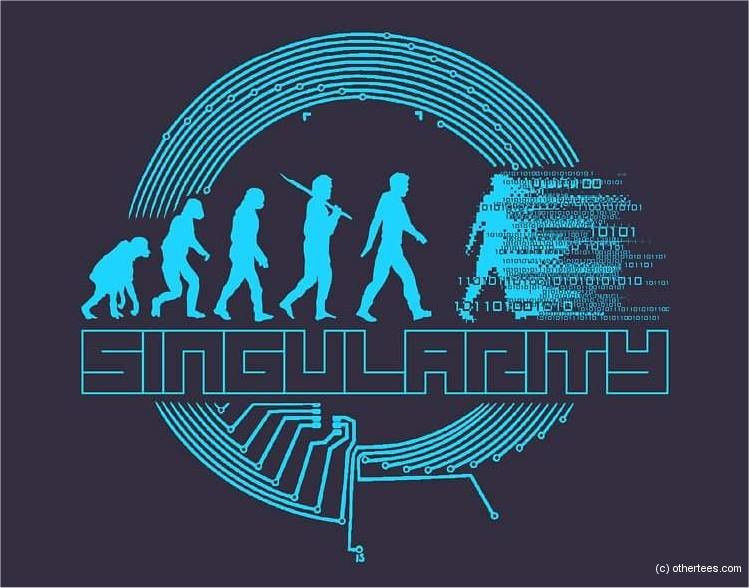
Today, AI offers another “let us.” The transhumanist Tech Bros desire it. They speak constantly of the “singularity” or of “consciousness.” Just have a search through Elon Musk’s X page. Here are some examples:
I want to know what is real, even if the answer is total obliteration of my consciousness.
Again,
Making consciousness multiplanetary is essential for its long-term survival
What is the singularity that will ensure the survival of a vague, dehumanized consciousness? Michael O’Fallon describes it well:
The Singularity is not merely a speculative milestone in artificial intelligence research; it is an ideological claim about the future of humanity. It posits a moment in which artificial intelligence surpasses human intelligence and then rapidly self-improves beyond human comprehension or control, producing an exponential cascade of technological change.
…
The Singularity narrative assumes the end of meaningful human agency, replacing it with a “post-human” condition in which artificial intelligence either governs human affairs outright or is fused with humanity in ways that dissolve the very concept of the human. Beneath the technical language lies a metaphysical commitment: that human limits are defects to be overcome, and that surrendering control to machine intelligence is not only inevitable, but desirable.
The task before us is not to accept an artificial god constructed in the image of elite ideology, but to defend the reality of human nature, human dignity, and moral responsibility against systems that would erase them.
The moment for clarity and resistance is now—before these transformations are normalized, institutionalized, and rendered functionally irreversible.
We must win…
O’Fallon is right.
Beware of the vague collective. Beware of those who speak of eating the rich. Beware of those who speak of human flourishing by saving the planet. Beware of the transhumanist language of consciousness and singularity. Understand what it means to be human.
We have very little time left to get this right.
For more on this theme, click here.
[1] James Lindsay, Stakeholderism and the Post-America Movement | James Lindsay, 45:33-45:57 – https://youtu.be/4u2ak-DmKD4?si=CmKtlTNeH0V2HphS
[2] James Lindsay, Stakeholderism and the Post-America Movement | James Lindsay, 32:28-32:55 – https://youtu.be/4u2ak-DmKD4?si=CmKtlTNeH0V2HphS
[3] Owen Strachan, Issues in Biblical Anthropology – Owen Strachan – Lecture 08
[4] Melvin Tinker, How the West was Lost, p. 43
Discover more from Standing Before God, This We Are and No More
Subscribe to get the latest posts sent to your email.
 Standing Before God, This We Are and No More