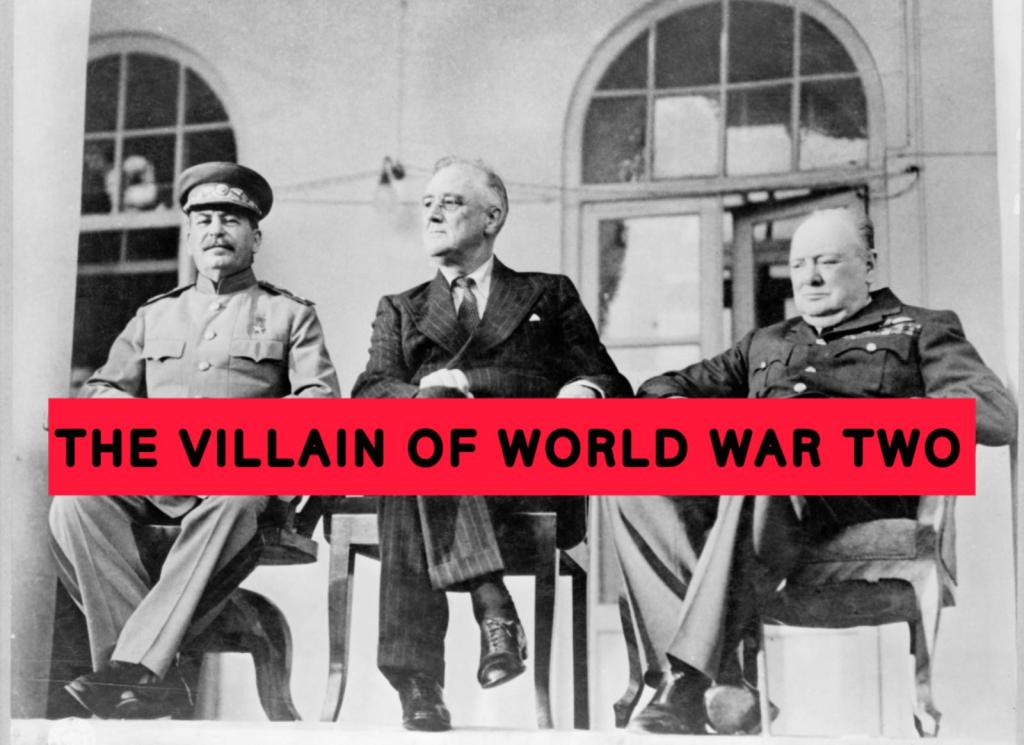
The facts and quotes in this article come mainly from three sources: the memoirs of Churchill, the journals of Stalin, and Viktor Suvorov’s book Icebreaker: Who Started World War Two.
I have no intention of trying to wade through the massive amounts of commentary made on Tucker Carlson’s interview with Darryl Cooper. Nor do I have any intention of addressing comments made by Tucker Carlson or Darryl Cooper from their interview, except for the (apparently hyperbolic) claim that Winston Churchill was “the villain of World War Two.” I will not refute this claim by defending Churchill, however. I will refute this claim by exposing the true main villain of World War Two.
Writing in his memoirs of the utter failure of the Soviets to anticipate Operation Barbarossa, which was the Nazi invasion of Russia, Winston Churchill wrote these words:
We must now lay bare the error and vanity of cold-blooded calculation of the Soviet Government and enormous Communist machine, and their amazing ignorance about where they stood themselves … They seemed to have no inkling that Hitler had for more than six months resolved to destroy them. If their Intelligence Service informed them of the vast German deployment towards the East, which was now increasing every day, they omitted many needful steps to meet it. Thus they had allowed the whole of the Balkans to be overrun by Germany … War is mainly a catalogue of blunders, but it may be doubted whether any mistake in history has equalled that of which Stalin and the Communist chiefs were guilty when they cast away all possibilities in the Balkans and supinely awaited, or were incapable of realising, the fearful onslaught which impended upon Russia. We have hitherto rated them as selfish calculators. In this period they were proved simpletons as well. The force, the mass, the bravery and endurance of Mother Russia had still to be thrown into the scales. But so far as strategy, policy, foresight, competence are arbiters, Stalin and his commissars showed themselves at this moment the most completely outwitted bunglers of the Second World War.
In this, Churchill was half right. The failure to counter Nazi Germany is, perhaps, the greatest militarily strategic blunder in all of human history. However, he was wrong to call the Soviets “simpletons.”
Hitler, the Simpleton
The Communists had dreamt of the day Germany would start a Second World War. In 1924, Stalin openly gave speech as to how a worldwide Communist Revolution would begin with Germany. He said in a speech on July 3, 1924, that “a revolutionary victory in Germany would be victory in the whole of Europe. If a revolutionary upheaval commences anywhere in Europe it will be in Germany. Only Germany can take the initiative in this matter, and the victory of the revolution in Germany will ensure the victory of the international revolution.”
This was the reason that the Soviets supported Nazi Germany for so long when, if they had not provided the support they had, the Third Reich could not have survived. As far as Stalin was concerned,
The Nazis had to be supported: leave it to the Nazis to eliminate the Social Democrats and the pacifists; let the Nazis start another war and destroy every state in Europe, every political party, every parliament, every army and every trade union. In 1927 Stalin already foresaw that the Nazis would come to power and he considered that this would be a positive event. ‘It is precisely this fact which will lead to an exacerbation of the internal situation in the capitalist countries and to the workers coming out in favour of revolution.
This, it would seem, was beyond the sight of Churchill, and outside of the comprehension of Western leadership.
Stalin saw the Nazis merely as a tool to be utilized, and then discarded. As Viktor Suvoro wrote,
Fascism was the hangman of Europe. Stalin supported the hangman, but even before the hangman had begun his work. Stalin had prepared the same fate for the hangman as awaited the hangman’s victims.” How was Stalin to accomplish such a feat? The Molotov-Ribbentrop Pact.
Stalin needed a situation in which ‘the capitalists will fight each other like dogs’. (Pravda, 14 May 1939) The Molotov-Ribbentrop pact created just that situation.
The Molotov-Ribbentrop Pact was the agreement between Germany and Russia to invade Poland. That September, the invasion was to begin on a set date.
Hitler trusted Stalin’s promise to invade Poland at the same time as Nazi Germany, thus sharing the blow of war with the Red Army, and, after it was over, sharing an extraordinarily long border with Russia, splitting Poland in two. Stalin, however, did not keep his promise. Germany invaded on the day agreed to. And Stalin waited two weeks until beginning the invasion on his end. And just like that, the true originator of World War II was scot-free, and the “simpleton” Hitler was blamed as the main villain of World War II – the only aggressor. Hitler had had no intention of beginning a war with the Western forces by invading Poland. Stalin, on the other hand, very much intended this.
The most outstanding achievement ever attained by Soviet diplomacy, [the Molotov-Ribbentrop pact, signed in the Kremlin] was Stalin’s most brilliant victory in his extraordinary career. ‘I have deceived him. I have deceived Hitler,’ cried Stalin joyfully after the Pact had been signed. (Nikita Khrushchev, Memoirs, Chasidze Publications, 1981) Stalin had indeed deceived Hitler in a way that nobody had deceived anyone else throughout the whole of the twentieth century. Only a week and a half after the Pact had been signed Hitler had a war on two fronts. That is to say, from the very outset of hostilities Germany fell into a situation in which it could only lose the war; or, to put it another way, on 23 August 1939, the day the Molotov-Ribbentrop pact was signed, Stalin had won the Second World War even before Hitler came into it.
Divide our enemies, meet the demands of each of them temporarily and then destroy them one at a time, giving them no opportunity to unite. (Pravda, 4 March 1941)
This was the policy of the Soviet State. And it (almost) worked to perfection. So, what went wrong?
In the final analysis, very little.
Years before the war started, Stalin went to work to build the greatest army in the world. He was by far the most prepared for it. After all, “Peace is a breathing space for war. So said Lenin, and so said Stalin and so said Pravda.”
The Red Army went from having less than 100 tanks to having 4,000; the three five-year plans produced nearly 25,000 aircraft. But the cost of his five-year plans was enormous. Ten to sixteen million of his own people died directly from the industrialization of Russia’s military, mainly through starvation.
At the close of the war, Stalin had half of Europe under his dominion. He had America largely calmed. And the only statesman who posed a real threat to the Soviet image as “ally” was a weird little Englishman by the name of Winston Churchill.
Still, Stalin did not achieve his worldwide Communist Revolution. There are a few reasons for this. The main one, perhaps, was Stalin’s arrogance — or, maybe equally, Hitler’s insanity.
As we have said, Hitler invaded Soviet Russia two months before Stalin intended to invade Germany. Stalin was not ready. His airfields were so close to the new Germany/Russia border that his aircraft couldn’t take off before being eliminated. More than this, his pilots were trained only for attacking ground targets, and not for engaging in dogfights. His tanks were outfitted for the motorways of Germany, and not for the rough roads of the Russian empire. Moreover, his tanks were designed to be more like artillery on tracks than as a match for the German Panzers. In short, Stalin’s army had, strategically speaking, no defense capabilities. They were an army raised for one purpose: going straight across Europe, crushing every enemy force in its way, without ever needing to stop.
If it was not for Hitler’s brazen invasion, the arrogance of Stalin would have paid off. But in the providence of God, the god of the Communists would not win the whole world. The global revolution failed; at least in that century it failed.
Churchill, the Simpleton
Hitler invaded Russia on June 22, 1941. It was a shock to Stalin, as has been recounted. Yet, from Churchill’s perspective, it should not have been.
On April 3, 1941, Churchill had warned his ally Stalin of the threat of German attack. He had investigated the troops movements of the German army on the Eastern-front, and had become convinced of Hitler’s intentions to invade. Churchill, on his part, wanted reprieve from the war with Germany through opening a second front to Germany’s Eastern border. Whether this was in the mind of Stalin and therefore prevented him from heeding Winston’s tip, or whether Churchill understood that Stalin would question his motives, may not ever be known. Yet, it is clear, that Churchill did not understand that Stalin was the villain of the World War he was in the middle of. And who could blame him, being largely along, an island against the German continent.
Still, if Churchill had gained Stalin’s ear, Communism would have swept over all of Europe, England, and then over the whole world. In his memoirs, Churchill remained indignant that his warning had gone undelivered for some time, and unheeded. He tells the story like this:
I also cast about for some means of warning Stalin, and, by arousing him to his danger, establishing contacts with him like those I had made with President Roosevelt. I made the message short and cryptic, hoping that this very fact, and that it was the first message I had sent him since my formal telegram of June 25, 1940, commending Sir Stafford Cripps as Ambassador, would arrest his attention and make him ponder.
[there was at this point a delay in the message being received, so it seemed]
I was vexed at this and at the delay which had occurred. This was the only message before the attack that I sent Stalin direct. Its brevity, the exceptional character of the communication, the fact that it came from the head of the Government and was to be delivered personally to the head of the Russian Government by the Ambassador, were all intended to give it special significance and arrest Stalin’s attention.
Sir Stafford Cripps sent the message to M. Vyshinsky on April 19, and M. Vyshinsky informed him in writing on April 23 that it had been conveyed to M. Stalin.
I cannot form any final judgment upon whether my message, if delivered with all the promptness and ceremony prescribed, would have altered the course of events. Nevertheless, I still regret that my instructions were not carried out effectively. If I had had any direct contact with Stalin I might perhaps have prevented him from having so much of his air force destroyed on the ground.”
Churchill, oblivious to the Mastermind of the war that threatened the survival of his island, sought to help his truest enemy in this strange moment of world history.
This was not obliviousness to the threat of the Soviet Union or of Russian Communism. It was, however, a simple way of looking at the conflict — a limited scope on the War. This perspective would change for Churchill, as he would become the only one of the Big Three to resist the wiles of Stalin.
The Villain
Of the many titles that might be given to Winston Churchill, whether for his public failures, personal vices, outdated views, triumphant successes, brilliant oratory, etc. — the title of “villain of World War Two” certainly does not belong to him. That titled belongs to one man: Joseph Stalin. It is as Trotsky said in 1936: “Without Stalin there would have been no Hitler, there would have been no Gestapo!”
All the streams of evil that flowed during World War Two can be traced to Stalin.
Stalin started World War Two.
He pre-meditated World War Two.
The conclusion is unavoidable:
Stalin is the villain of World War Two.
Discover more from Standing Before God, This We Are and No More
Subscribe to get the latest posts sent to your email.
 Standing Before God, This We Are and No More
One thought on “The Villain of World War Two”