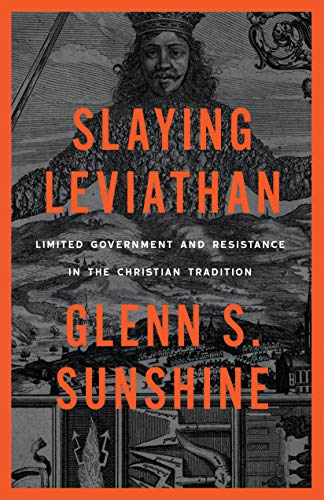
When I picked up Slaying Leviathan I wasn’t expecting to read a complete history of Western political thought and the resistance of the Christian Tradition to tyranny (or Leviathan, as the author calls a tyrannical state). This book is helpful is setting our perspective on a long history of development, and therefore helping us see where we stand in that history. Reading it, I felt my heart wanting to act as I saw parallels and implications to my own day.
Sunshine has done a great job of presenting the history of “limited government and resistance in the Christian tradition.” Sunshine has mixed what the people he writes about thought with the situation they encountered in their own day, making his book both rich and historically informative. It is a succinct and accurate historical account.
If you are new to Christian political thought or the history of church history on a grand level, this book is a good place to start. It’s not uber wordy or imposing, and it’s a fun book to think through. The book is worth buying for those reasons alone. (If you would like to read some quotes from the book that I thought were worthy to put into my own note books, click here. They are the best endorsement of this book I can give.)
That said, I need to spend some time on what I did not like about Slaying Leviathan. I want to say strongly that I DO think the book is worth buying; and it’s one that, even for its faults, I will read again and reference. That said:
Lacking Clarity
I think this book should have been part one of a two-part series. It would have been far better if he had written this as a historical book, and then wrote another book drawing out implications for today. When he does get around to building a practical defense today against Leviathan, it feels inadequate to the history he has relayed – an Epilogue that should’ve been made into its own book.
The last chapter and the Epilogue don’t mesh well. At the end of the last chapter, he writes of the current situation in America and warns us that “This is how Leviathan is reborn.” Then, in the Epilogue, speaking of our present context he states that “we are fighting a reborn Leviathan.” I am left wondering which it is, and what exactly the point of the book I just read was.
Sunshine does not seem to have a clear grasp on our own times. While I do think this book would be markedly improved if it had a sequel, I don’t think I would like the sequel. As already referenced, the Epilogue is the weakest part of the book. What people are to do today is not clear, despite that being the point of the Epilogue. I think it would have been better to have left out the Epilogue and allowed people to discern for themselves from the rest of the history taught in the book what they should think and do.
Lacking Scripture
The distinct lack of the Bible in this book is worrisome. Outside of references to Genesis 1-3 and Romans 13, very few explicit references to the Bible are made. It seems odd, even if the argument is made that “This is a book about the Christian tradition, not the Christian Text,” that so little is made of the development of views on passages of Scripture. But of course, that’s another whole problem.
Sunshine gives Aristotle a lofty position throughout this book, a position Aristotle retains even after the Reformation, through the Puritan era, to the founding of America. While the huge influence of Aristotle in the pre-Reformation era over Medieval political thought is undeniable, the variance the Reformers had with the Philosopher is not emphasized enough. Nor is the fact that the Puritans in general drew far more from the Scriptures than they did from Aristotle – not to mention Luther and Calvin! Again, Aristotle had a huge impact of Christian political thought, but emphasizing him over the Bible in the Reformers and Puritans political theory seems to be a bit much.
Lacking Gospel
Furthermore, on this same point, I disagree with the statement on page 176, in response to “How are we to respond to the threats to liberty we are facing?” (page 174), that “the most powerful tools at our disposal is corporate worship and prayer.” Those are undeniably great tools in the killing of leviathan. But why is the proclamation of the Gospel not center-stage? Surely since the only true and best defense of a Republic and resistance of tyranny is virtuous people, and since the Gospel is the way by which the Holy Spirit transforms sinners into virtuous people, it’s proclamation should be our primary weapon? Again, yes prayer and worship; but why is the Gospel missing?
Indeed, the Gospel is missing in this entire book. Though the communication of the Gospel is not the primary task of this book, and though I am sure Glenn Sunshine believes, surely it should be somewhere? If our enemy is “The state… as a single entity made up of individuals bound together in an omnipotent, immortal, and indivisible whole under its head, the king” (page 123), surely our best response (our only response) is our King, who is truly omnipotent, omnipresent, immortal, invisible, etc.? In this great war against the hideous dragon, how can books like this leave out our great Warrior Savior?
To sum up: this book is historically informative, deeply stirring, but lacking in clarity, in Scripture, and in Gospel.
If you would like to buy the book, let me suggest buying it from Canon Press – https://canonpress.com/products/slaying-leviathan/
Discover more from Standing Before God, This We Are and No More
Subscribe to get the latest posts sent to your email.
 Standing Before God, This We Are and No More
One thought on “Slaying Leviathan Book Review”