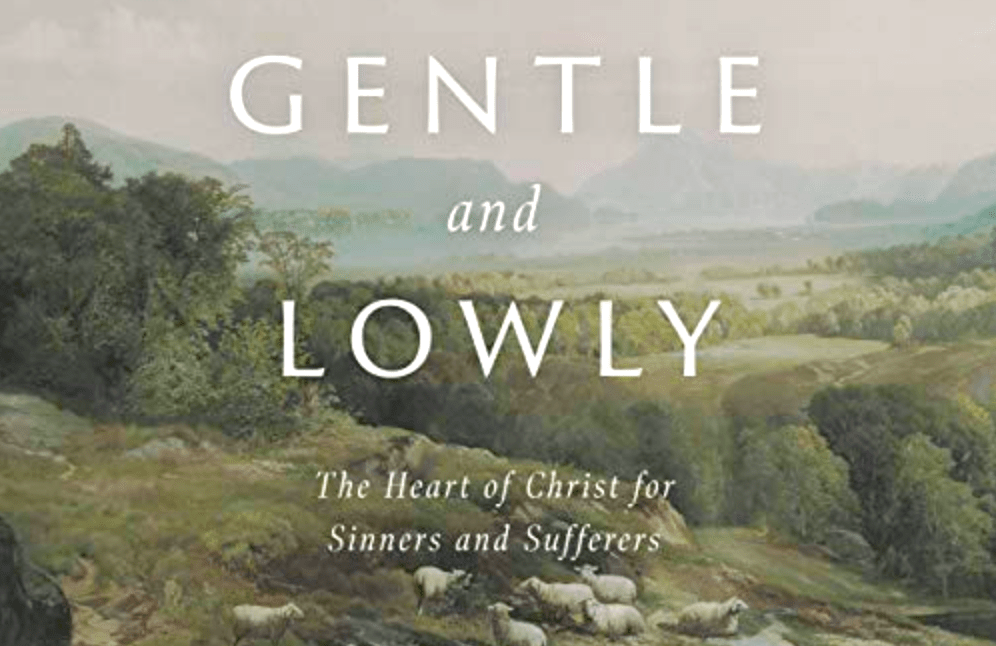
A response to Jon Harris’ “Gentle and Lowly: A Review”
This is not meant to be a defense of Dane Ortlund, or any of those who endorsed his book. Nor is this an attack on Jon Harris. This is a defense of Ortlunds book, and more crucially, it is a defense of the true theology he presents in his book. And, in giving this defense, I pray it defends Dane Ortlund in the areas he is Biblically faithful.
Gentle and Lowly came out in 2020. I received it as a gift and read it throughout 2021 with someone very wise. Though the current controversy about the book is new to me (I have only just learned about it this week), the current concerns being raised about the book are not. They were not lost on me when I read it. Some of the endorsements at the beginning of the book made me uneasy. Some sentences and tactics concerned me. But after spending a lot of time last year reading the book itself, thinking through its deep theology, reading the Scripture it quotes, and talking about it with the person I was reading it with, those concerns have receded. So I’ve decided to write a response to a particular review, in hopes that I might not only defend the theology presented Gentle and Lowly, but also help in untangling some of the mess.
Jon Harris is someone whose work I have found courageous and insightful. The issues he addresses are some which very few are willing to. He is a valuable resource for that. He is a concerned theologian who runs an informative podcast addressing many issues others shy away from. That being said, as we begin with this particular video, I think it is crucial to notice a statement he makes towards the beginning:
I am going to give you some of my personal and fresh insights that I have into this. I did listen to it on audible as I was doing work on the house, so I didn’t take notes, I wasn’t being as careful as I was with some books, but I was looking for general themes. Trying to think though red [or yellow] flags if they came up. And I have some general thoughts to share with you, and then I’ll illustrate this with some quotes (Harris 4:50-5:20).
First, I appreciate this openness to what he is doing in his review, and what his source information is. There is certainly a place for this kind of review. In my oppinion, however, I think that is probably more amiable for conversations about the book with friends or church members than it is for a podcast. With that in mind, this should clearly not be a review that makes up your mind on whether you accept it or reject it, read it or not. There is a problem though, because Harris says that he wouldn’t recommend it. He says that “it’s so murky in the way that it is written—it’s just not written well. I wouldn’t recommend it just for that” (Harris 10:34-41). “It’s sloppy” about its presentation of theology proper (Harris 5:49). Remember, this is said despite the fact that he doesn’t say it is false teaching, and with the backdrop of being a best seller and highly recommended even on the local church level. Wouldn’t it be better to raise these concerns, and urge your hearers to read the book carefully, not just accepting it because it is a best seller, or because someone you trust recommended it?
Structure.
Harris divides his review into four general critiques, and backs them up with quotes at the end, with some major overlap between the critiques. This post will deal with them one at a time, bringing in the specific quotes Harris cites at the end into each of his critiques.
Harris First Critique: Christ’s heart
The thesis of the book seems to be that if you drill down deep into the heart of Jesus, and you see who He fundamentally is at a very basic level—the real authentic Jesus, you’re going to find gentle and lowly. And this is the heart of Jesus (Harris 5:22-5:37).
Harris’ concern?
That can be a dangerous thing. If you really take that away. If you prioritize this gentle and lowly aspect of Christ over everything else (Harris 6:39-6:49).
Harris grounds this concern in the very Scripture passage that Ortlund cites for the title and central theme of his book, Matthew 11. First, let’s look at what Ortlund said. Citing Matthew 11:29, that this is “Christ’s very heart,” Dane writes:
“Gentle and lowly.” This, according to his own testimony, is Christ’s very heart. This is who he is. Tender. Open. Welcoming. Accommodating. Understanding. Willing. If we are asked to say only one thing about who Jesus is, we would be honoring Jesus’s own teaching if our answer is, gentle and lowly (Ortlund 21).
Harris suggests that Ortlund emphasizes the gentleness and lowliness of Christ over everything else, including wrath and justice for sin, ignoring the context of Matthew 11. But this is just sloppy on his part. For the very next paragraph that Ortlund writes clears all of this up:
This is not who he is to everyone, indiscriminately. This is who he is for those who come to him, who take his yoke upon them, who cry to him for help. The paragraph before these words from Jesus gives us a picture of how Jesus handles the impenitent: ‘Woe to you, Chorazin! Woe to you, Bethsaida! . . . I tell you that it will be more tolerable on the day of judgment for the land of Sodom than for you’ (Matt. 11:21, 24). ‘Gentle and lowly’ does not mean ‘mushy and frothy.’ But for the penitent, his heart of gentle embrace is never out-matched by our sins and foibles and insecurities and doubts and anxieties and failures (Ortlund 21).
Harris is right. This is a possible danger. But Ortlund doesn’t make it easy for someone to walk away thinking that. Dane’s position is clear.
Later Harris quotes this from the book:
And if the actions of Jesus are reflective of who he most deeply is, we cannot avoid the conclusion that it is the very fallenness which he came to undo that is most irresistibly attractive to him (Harris 30).
His concern? “Jesus is not attracted to our sin” (Harris 15:47-15:49). First, Dane didn’t say that Jesus is attracted to our sin, but to our fallenness—and that has a context and specific way in which Ortlund is using that in the flow of his writing. He makes it clear in the paragraph right after this, that he means that Christ has compassion on the fallen world in sin, and that He wants to move in closer to “undo” that, not withdraw from His people. Dane is not speaking about sins being attractive, or sinners who will remain unrepentant and who are not among His fold being attractive, but His own chosen people, however drenched and dead in sin being those to whom He is unwaveringly gracious to. They are still attractive to Christ—not because of who they are, but because of who He is notwithstanding what they are. If you read the flow of the book, I think you will agree that this is Ortlunds point.
Second, Ortlund is not saying that the reason Christ loves and saves us is because of our sin. That would be a massive issue, and a false gospel which is pervasive today. A false gospel that is works based, just not good works based. A gospel that says that Jesus loves you because of your sin, and that you merit His grace by your sinful works. Ortlund is not saying that, though I agree that the wording isn’t clear in this sentence unless you follow carefully his train of thought. Ortlund is saying that Christ, seeing His elect Bride in sin and suffering, only draws out His heart more for her. Let me just quote three times from early in the book.
This is deeper than saying Jesus is loving or merciful or gracious. The cumulative testimony of the four Gospels is that when Jesus Christ sees the fallenness of the world all about him, his deepest impulse, his most natural instinct, is to move toward that sin and suffering, not away from it (Ortlund 30).
In other words, when Hebrews 5:2 says that Jesus “can deal gently with the ignorant and the wayward,” the point is that Jesus deals gently and only gently with all sinners who come to him, irrespective of their particular offense and just how heinous it is. What elicits tenderness from Jesus is not the severity of the sin but whether the sinner comes to him. Whatever our offense, he deals gently with us. If we never come to him, we will experience a judgment so fierce it will be like a double-edged sword coming out of his mouth at us (Rev. 1:16; 2:12; 19:15, 21). If we do come to him, as fierce as his lion-like judgment would have been against us, so deep will be his lamb-like tenderness for us (cf. Rev. 5:5–6; Isa. 40:10–11). We will be enveloped in one or the other. To no one will Jesus be neutral (Ortlund 54).
Jesus can no more bring himself to stiff-arm you than the loving father of a crying newborn can bring himself to stiff-arm his dear child. Jesus’s heart is drawn out to you. Nothing can chain his affections to heaven; his heart is too swollen with endearing love (Ortlund 55).
If Harris really read the book carefully, which he didn’t, I think he would have been fair enough to acknowledge all of this, and hopefully to go to the chapter where Ortlund spends an entire chapter dealing specifically with this, titled “What Our Sins Evoke.” For in that chapter, Ortlund is making clear the heart of God towards those who are outside of Christ (wrath) and those in Christ (love). Dane makes clear that Christ deals with His people in such a way as to seek to eradicate their sin from them, that He might save them to Himself.
We could go through the entire book, but that would be to spoil it. So, I recommend it to you, reader, that you might see Christ’s heart, and God’s heart for His people in Christ even in these often dark and gloomy times.
Harris’ Second Critique: sloppy and vague
This critique just emphasizes the first, restating that concern the way in which Ortlund presents Christ’s nature, character, and heart as confusing. And I think the quotes above refute that already. However, there is one statement Harris makes that needs to be refuted.
I think because it is so emotionally driven, it’s not a precise theological book. It is a self-help book, okay let’s be honest. This book is a self-help book. And so there’s nothing necessarily wrong, but I do see dangers for man-centeredness. I do see dangers for just sloppiness. And I do see an emphasis that I think is a little lopsided (Harris 11:11-11:33).
This could not be further from the truth, or more unfair to Dane Ortlund. And this time I will come out full on and defend Ortlund himself. Harris really should have cared enough to give Ortlunds book justice before uploading this video, and he just hasn’t. Here is the “application” that Ortlund makes at the end of the book—and it is brilliant. It steers clear of a lot of the legalist antinomian stereotypical way of applying theology and just cuts straight to the chase:
This is a book about the heart of Christ and of God. But what are we to do with this?
The main answer is, nothing. To ask, ‘Now how do I apply this to my life?’ would be a trivialization of the point of this study. If an Eskimo wins a vacation to a sunny place, he doesn’t arrive in his hotel room, step out onto the balcony, and wonder how to apply that to his life. He just enjoys it. He just basks.
But there is one thing for us to do. Jesus says it in Matthew 11:28.
‘Come to me’ (Ortlund 215).
And then, for good measure, Dane quotes the theological legend Thomas Goodwin to press home the point. I consider that refutation enough since Harris did not supply any quotes that remotely seem to be “self-help.”
Harris’ Third Critique: emotional and effeminate?
It is very emotionally driven… it comes across as effeminate (Harris 10:49-10:58). There’s a lot of almost semi-romantic kind of ways of describing the relationship between Christ and Christians (Harris 11:02-11:10).
Throughout the video, Harris describes Gentle and Lowly as “romantic.” Now I understand where this is coming from. Harris himself says that he would rather see “the very deep love that God has for us where He chose to sacrifice [Himself]. That Agape love” (Harris 21:08-21:15). There can be, and has been, a false view of Christ that reduces Him to a source of emotional fulfillment alone. But this isn’t what Ortlund does. In fact, I think Ortlund does what Scripture does. Time and time again Scripture speaks—God speaks of His heart for His people, His heart for His Bride, in very “romantic” language. God says to His people that for all their sinfulness and waywardness, He is not finished. He has not given up. His heart has not receded from His own, from those He loves in Christ. Who could deny that He uses romantic language to communicate this?
“Therefore, behold, I will allure her, and bring her into the wilderness, and speak tenderly to her. And there I will give her her vineyards and make the Valley of Achor a door of hope. And there she shall answer as in the days of her youth, as at the time when she came out of the land of Egypt. “And in that day, declares the Lord, you will call me ‘My Husband,’ and no longer will you call me ‘My Baal.’ And I will betroth you to me forever. I will betroth you to me in righteousness and in justice, in steadfast love and in mercy. I will betroth you to me in faithfulness. And you shall know the Lord.”
Hosea 2:14-16, 19-20.
As Ortlund writes of the affection of Christ’s heart for His people—using romantic language to do so, he does not leave the text of Scripture to do so. In fact, backing up his writing with the best of theologians, Dane seeks to describe the depth of Christ’s love and the overflowing abundance of His heart. “A love that isn’t tied to our loveliness. A love that gets down underneath our messiness. A love that is bigger than the enveloping darkness we might be walking through even today. A love of which even the very best human romance is the faintest of whispers” (Ortlund 168).
This can be clearly seen in his treatment of Hosea 11. Ortlund operates out of Hosea 11 on pages 72-75, and 141-142. Now, just to bring someone else in on this point and set the stage for examining Hosea 11, John Stott called this passage “Perhaps the boldest of all human models of God in Scripture is the pain of parenthood which is attributed to Him…” (Stott 129). Hosea 11 is the Triune God expressing to His sinful people the depth of His compassionate love for them. And I think this is just how Ortlund portrays it, especially in one particular statement which could likely summarize Dane’s theology of the affection of God for His people:
The key observation is this: it is in consideration of his people’s sins that God’s heart goes out to them in compassion … We are given a rare glimpse into the very center of who God is, and we see and feel the deeply affectional convulsing within the very being of God. His heart is inflamed with pity and compassion for his people. He simply cannot give them up. Nothing could cause him to abandon them. They are his (Ortlund 72-73).
Harris says that what “We really need right now the courage to stand up.” And while this is very true, he doesn’t stop there. “This is the theme, though, this more feminized theme is what we see repackaged over and over and over” (Harris 21:33-21:40). Today we do see increasingly effeminate men and effeminate writing in general. But Ortlund doesn’t do that. And the theology behind the language that he uses isn’t feminized theology, but Biblically derived, Puritan driven theology. And if Harris is going to contend with statements in the book like this one which he brought up: “The gospel is the invitation to let the heart of Christ calm us into joy, for we’ve already been discovered, included, brought in. We can bring our up-and-down moral performance into subjection to the settled fixedness of what Jesus feels about us” (Ortlund 187), he is going to have to exegete passages like Hosea 2 and 11.
We cannot abandon the depth of romantic theology. It is the way in which the Maker of the created world in which romance exists saw fit to communicate Himself. Diminishing romantic theology revelation diminishes Christ. Diminishing romantic theology because we think it is effeminate diminishes femininity, and diminishes Christ-like manhood. And women no longer no what womanhood is supposed to be. It diminishes His Bride. And it destroys Christ-like love within the family and within the church.
Yes, we need courage. We need people willing to contend for truth, for the sake of Christ in whom all truth holds together. We need to emphasize that Jesus is the courageous warrior King. We also need the love of God in Christ for His Bride, do we not? Was not that love behind the sacrifice of Jesus for us? Ought not the motive for sacrificial living be the glorious gracious love of Christ for His people? Isn’t that how the Spirit has said He will work in families and churches? And ought not that love be the power that motivates and launches the church into the greatest theological war in the past five hundred years? If it isn’t, we need to reexamine how Paul talks about Christian life and spiritual conflict in Ephesians 4-6. And if we want men who have a type of courage and a form of manliness, without hearts first shaped by the love of God, which then becomes a love like Christ has for His Church for their families and their churches, then we are asking for monsters, not men.
Harris’ Fourth Critique: why so popular… now?
Here’s my fourth general critique. The reason I think it’s lopsided in part, and the reason it feels a little unusual, and why Russell Moore likes it, is I think because right now we face tyranny from the government (so threat from without) and then from within the social justice movement… ripping Christianity apart everywhere, this is not necessarily the main thing that you would think would be popular under these circumstances. You think a book about… Jesus being a brave courageous figure who decided to make the greatest sacrifice of all time, and deprived himself of his own attributes, His non-communicable attributes that he had it as being God. He chose to humble himself, as Philippians talks about. And then delayed gratification, doing it for a higher purpose, doing it for the Lord; we need books about that. We need that emphasized.
We need men who have courage who don’t care if… they’re rejected from the cool kids table.
It’s the theme [courage, specifically masculine courage] right now you’d think would be front and center because of the threats, because of the sacrifices people are already having to make, and it’s just not there. And so, in its place is a popular book like this.
Why is that so popular right now? Because we do need that. We do need to know that Jesus accepts us. He receives us, He loves us, He takes away our sin. We can’t do anything to separate His love from us. But at the same time, why is that the emphasis? Why is that the big theme right now?
This is the Jesus that people want to portray to “the watching world” quote unquote. It’s a more attractive Jesus. If you really emphasize that. If you really say at the core, deep level, this is really who he is—the other stuff isn’t quite as important (Harris 11:33-15:27).
That is a lot. Let’s try to tackle this a bit at a time. First, one theological issue is heretical: that Jesus gave up His God-ness, or His “non-communicable attributes that He had as being God” in becoming truly human. That statement is heretical through and through, though I don’t think intentional nor what we believes at all. But nonetheless, he said it in this video, and it demands calling out.
Second, we cannot allow what we are contending with to determine what our position is. It is possible to get tunnel vision when doing apologetics. And I think Harris probably experiences some of this, as all apologists can, as he contends with Critical Theory. That is why we need to be reminded sometimes of who we are contending for, and what He is like. Yes, Ortlund presents “a more attractive Jesus.” But the issue is, is Jesus like that? I encourage you to read the book, but more importantly, read the Book He gave to you so that you could know exactly who He is, without the erring words of mortal men—however wise and godly they are.
Third, Russel Moore. Moore is someone who has gone theologically haywire himself, and who I have many issues with. And the fact that he and Ortlund have been in conversation together, and that he wrote an endorsement to be printed on the first page of Ortlund’s book, does raise concerns for me. The question is, however, has Ortlund gone towards the social justice gospel that Moore seemingly has? I don’t think so. Should we be concerned and be able to pray well about this? Oh yes. And that is why I respect what Jon Harris is trying to do.
Fourth, we cannot let the entrance of critical theology theory into the church to shape true theology. And we dare not find ourselves contending against those things that come against the faith once for all delivered to the saints, without the reason behind our fight being because of that faith.
Fifth, Josiah Ley comments on the video, “Not the right message we need right now? Knowing and deepening our understanding of the character of Christ (the entire premise of the book) isn’t needed? Wow.” He is right. Watch to the video, but it is clear that’s what Harris said. And though I am as at least as convinced of the dangers today as Harris is, I think that this is the time when knowing Christ is needed most! In fact, against tyranny and false teaching, the deep reality of who Christ is is the only hope.
Sixth, Ortlund’s audience. This is a point that was brought up in the comments by a gentleman calling himself Max Strange (to give credit where credit is due). Dane writes at the beginning of the book,
This book is written for the discouraged, the frustrated, the weary, the disenchanted, the cynical, the empty. Those running on fumes. Those whose Christian lives feel like constantly running up a descending escalator. Those of us who find ourselves thinking: “How could I mess up that bad—again?” It is for that increasing suspicion that God’s patience with us is wearing thin. For those of us who know God loves us but suspect we have deeply disappointed him. Who have told others of the love of Christ yet wonder if—as for us—he harbors mild resentment. Who wonder if we have shipwrecked our lives beyond what can be repaired. Who are convinced we’ve permanently diminished our usefulness to the Lord. Who have been swept off our feet by perplexing pain and are wondering how we can keep living under such numbing darkness. Who look at our lives and know how to interpret the data only by concluding that God is fundamentally parsimonious (Ortlund 13).
Ortlund’s audience isn’t everyone. It is Christ’s people. And I think he qualifies the points he makes in the book to clarify that for those who skipped this paragraph, and for unbelieving readers.
Conclusion
Harris’ review is unhelpful and muddled. Gentle and Lowly, on the otherhand, is helpful on many levels. It is a good introduction to good puritan theology. It is a challenging yet intriguing read for most. And it is a Biblical book. No book is perfect, and this one has its flaws and its pitfalls. But the book itself does not contain bad theology. It contains theology that the devil has done his best to muddle and muddy so that no one understands it. So, I recommend the book. Not because of who wrote it, or because of who did or didn’t endorse it, but because of the theological help it provides. In short, I think Dane Ortlund has written a theologically solid and refreshing book in a time of false and distorted theology.
As for Harris, I still respect him and his work, but he really screwed this one up. And I think it is only consistent to refute him fairly, which is what I have sought to do. I consider this a good reminder of a couple things. One is to read a book seriously, especially before you review it for over six thousand people to watch. Another is to keep our eyes always fixed on who Christ is, regardless of our circumstances. If this has served to do either of those things, I will consider it a worth while effort.
References:
Ortlund, Dane C. Gentle and Lowly. Wheaton, Illinois: Crossway, 2020. Book.
Stott, John. The Cross of Christ. Dowers Grove, Illinois: InterVarsity Press, 2006. Book.
Discover more from Standing Before God, This We Are and No More
Subscribe to get the latest posts sent to your email.
 Standing Before God, This We Are and No More