Read Part 1-Introduction.
Racism is at the center of the division in America, both in the country’s history and in the present hostilities it is experiencing. “Racism,” defined by the Presbyterian Church in America, “is an explicit or implicit belief or practice that qualitatively distinguishes or values one race over other races” (qtd. in Piper, Bloodlines 239). Many Americans, however, have a more “street level” definition of race, which John Piper defines as “…a group of people distinguished primarily by skin color, but also by facial features and hair type” (Structural Racism, The Child of Structural Pride). Street level racism, then, would be prejudice based on these external physical appearances. And to many Americans, the diagnosis of street level racism is clear: one person hates or is disgusted by another person on the basis of their skin color. The prescription for racism, therefore, is to simply remove one’s racially motivated hatred or disgust. While this kind of definition, diagnosis, and prescription may be accurate in many ways when it comes to racial prejudice on an individual or street level, the problem of racism goes much deeper than this. Racism (predominantly understood today) stems from three main ideologies, ideologies which go far beyond dividing humanity into races. They are the ideologies of cultural hegemony, critical race theory, and intersectionality.
Hegemony, or cultural hegemony, was an idea originally introduced by the Marxist intellectual Antonio Gramsci (145). Hegemony can be defined as “the social, cultural, ideological, or economic influence exerted by a dominant group” (“hegemony”). A more accurate and widely accepted definition, however, would be that “Cultural hegemony refers to domination or rule maintained through ideological or cultural means.” This domination is maintained through institutions, which allows the ruling hegemonic power to control the aspirations, worldviews, and the daily lives of other subordinate groups within the culture (What Is Cultural Hegemony?). In the United States, the argument is made that “The cultural hegemony” is, “for example… white, male, heterosexual, cisgendered, able-bodied, native-born, Americans” (Baucham, Cultural Marxism). On what basis does someone determine that this is the cultural hegemony of America? That question is answered by critical race theory and intersectionality.
Critical race theory stems from the concept of hegemony, and is basically synonymous with intersectionality (intersectionality being that which expounds critical race theory and explains specific classifications of oppression within the theory). Even though the term “intersectionality” was coined in the late 1980’s, it derives its root from critical race theory (Columbia Law School). Both of these ideologies are the brainchildren of a group of scholarly intellectuals referred to as the Frankfurt School. Recognizing the common origin of these theories in modern times is important because you cannot separate critical race theory from intersectionality because they mutually depend on each other for their soundness.
“Critical race theory, the view that the law and legal institutions are inherently racist and that race itself, … is a socially constructed concept that is used by white people to further their economic and political interests at the expense of people of color [which is the idea of white privilege]. According to critical race theory, racial inequality emerges from the social, economic, and legal differences that white people create between ‘races’ to maintain elite white interests in labor markets and politics, giving rise to poverty and criminality in minority communities” (Curry). Critical race theory, then, further expounds hegemony. It carries with it the idea that there can be race on race crime, as well as class on class crime, rather than just individual on individual crime. Critical race theory determines not merely that the hegemony of a culture oppresses the “minority” groups in their society, but also that the hegemony is actively hostile against those “minority” groups. Therefore, all efforts to overthrow the hegemonic power of a culture are considered valid within critical race theory. This is where the concept of intersectionality becomes so important to critical race theory and the divide seen in America today.
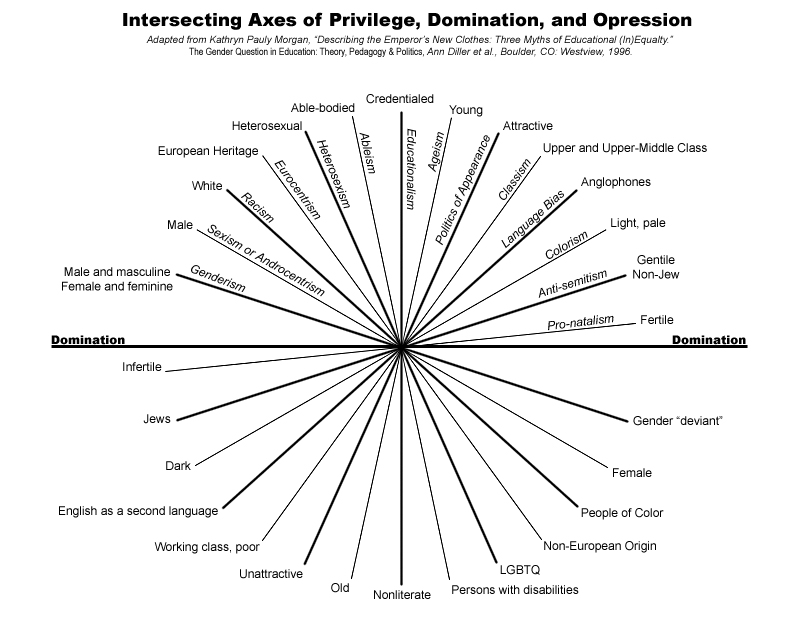
“Intersectionality within CRT [critical race theory] points to the multidimensionality of oppressions and recognizes that race alone cannot account for disempowerment” (Smith). “Intersectionality, in a nutshell, is the idea that to the degree that you don’t have those things [those privileges] you are oppressed” (Baucham, Cultural Marxism). And one’s oppression is limited based on how many of those privileges an individual does not have. For example, if someone is white but not male, then that person’s oppression is limited to his being racially white. And the inverse is likewise considered to be true: the degree to which someone has those privileges is the degree to which they oppress those who do not. So, if someone is a white male, that person oppresses those who do not have the hegemonic privilege of being white and/or male. These degrees of oppression and the types of oppression that someone experiences overlap and combine themselves in areas that determine cultural and racial privilege; these are called intersections of oppression (see figure 1 for a visual representation of the intersections of oppression). Who oppresses and is oppressed, then, is not about the individuals themselves, but about the “group” or “groups” to which the individuals are categorized as belonging to (Baucham, Cultural Marxism).
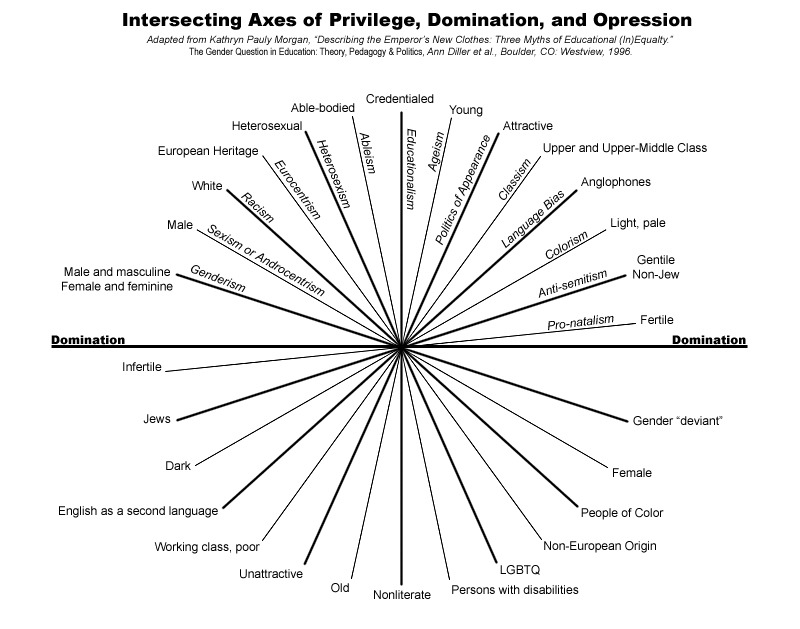
Figure 1
https://24.media.tumblr.com/tumblr_m1ms3kgBke1qimo8yo1_1280.jpg
And this, critical race theory paired with intersectionality, leads individuals to view themselves, “not as part of a whole, but as part of subgroups—as part of subgroups who, in some way, shape, fashion or form, are being oppressed by the hegemonic power that rules and governs our culture” (Baucham, Cultural Marxism), which goes far beyond considerations of race. This is the worldview that has enveloped American culture and is at the center of the divide seen in the American political sphere and in group-based divisions. And once someone understands the ideologies underlying the worldview, it does not take them long to discover just how pervasive and predominate it actually is in every sphere on the American culture—in the understanding of ethnicity, in the area of politics, and in the realm of entertainment.
Discover more from Standing Before God, This We Are and No More
Subscribe to get the latest posts sent to your email.
 Standing Before God, This We Are and No More
6 thoughts on “Cultural Disunity and the Triune God, Part 2–Racism, Hegemony, Critical Race Theory, and Intersectionality”